What Is a Synonym? The Clear Guide to Using Them Right 2026
Introduction
Have you ever found yourself typing the same word three times in a paragraph and thinking, there has to be a better way? You’re not alone. Every writer, student, and professional hits that wall. That’s exactly where synonyms come in — and once you understand what is a synonym and how to use it well, your writing transforms almost instantly.
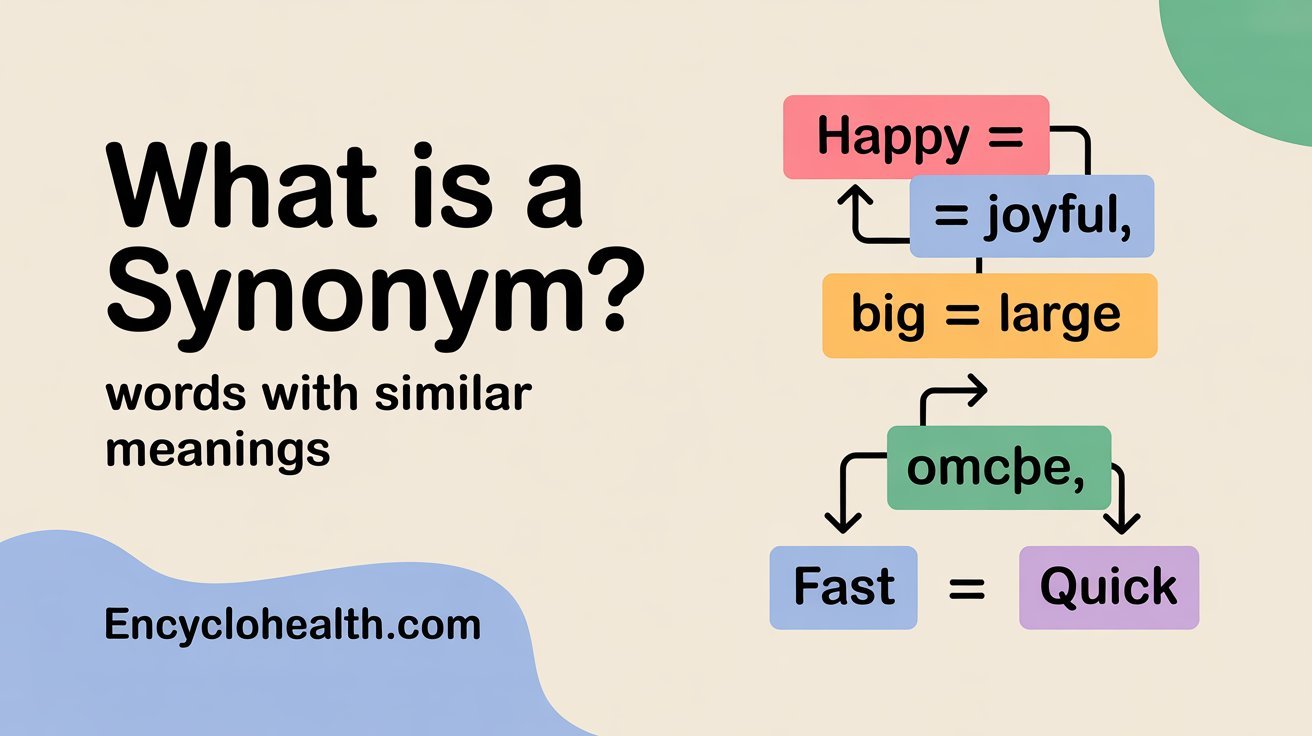
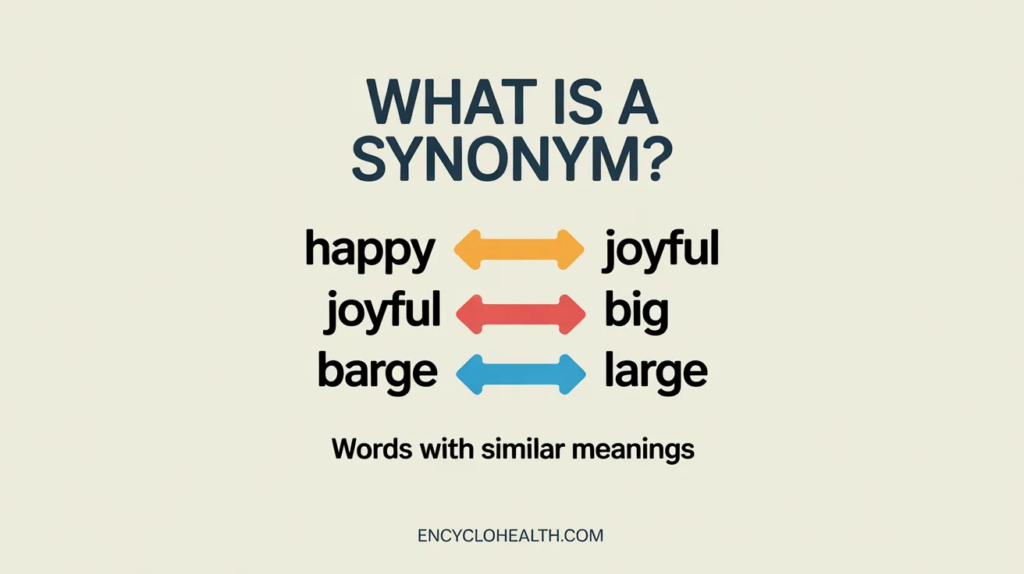
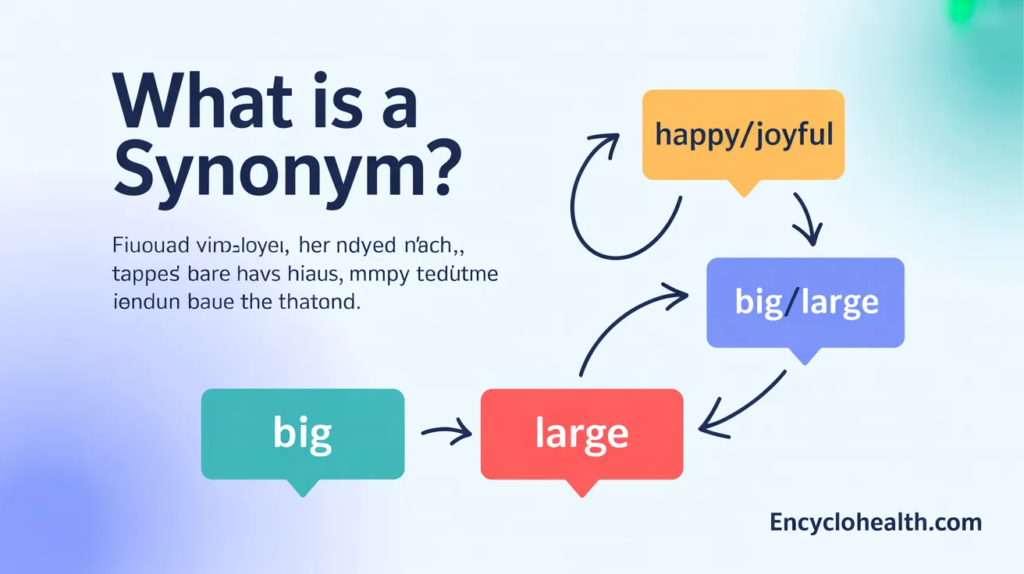
A synonym is simply a word that means the same thing — or nearly the same thing — as another word. “Happy” and “joyful.” “Big” and “large.” “Fast” and “quick.” Simple idea, right? But there’s a lot more to synonyms than just swapping words around. The nuances matter. The context matters. The tone matters.
In this article, you’ll learn what is a synonym in plain terms, explore the different types, see real examples, and get practical tips for using synonyms to make your writing sharper, cleaner, and far more engaging. Let’s get into it.
What Is a Synonym, Really?
At its core, a synonym is a word or phrase that carries the same or very similar meaning as another word in the same language. The word “synonym” itself comes from the Greek words syn (meaning “together”) and onoma (meaning “name”). So literally, it means “together name” — two words that share a name, or a meaning.
Here are some everyday examples you already know:
- Begin / Start / Commence
- Angry / Mad / Furious
- Smart / Clever / Intelligent
- Beautiful / Pretty / Gorgeous
- Sad / Unhappy / Melancholy
Each group shares a core meaning. But notice how they feel different? “Commence” sounds formal. “Start” sounds casual. “Begin” sits right in the middle. That’s the beauty — and the challenge — of synonyms.
Understanding what is a synonym means understanding that words are rarely identical. They’re similar, but they carry different weights, emotions, and social vibes.
Why Synonyms Matter More Than You Think
You might be wondering — why not just use the same word repeatedly? Why bother with synonyms at all?
Here’s the honest answer: repetition kills good writing. When you read the word “good” five times in a paragraph, your brain starts to tune it out. The word loses meaning. It becomes wallpaper. Synonyms are the solution to that problem.
But synonyms do more than just break up repetition. They:
- Add precision. “Thin” and “slender” both describe someone’s body — but “slender” sounds elegant, while “thin” can sound clinical.
- Set tone. “Laughed” vs. “chuckled” vs. “cackled” — all mean laughing, but each tells a different story.
- Expand your vocabulary. The more synonyms you know, the more tools you have to express exactly what you mean.
- Improve readability. Varied word choice keeps readers engaged and makes your writing flow better.
- Help with SEO. If you’re writing for the web, synonyms help you hit related search terms naturally without stuffing one keyword everywhere.
Research in linguistics backs this up too. Studies in cognitive psychology show that readers process varied vocabulary more actively than repeated words. In other words, word variety literally keeps brains more engaged.
The Different Types of Synonyms
Not all synonyms are created equal. This is where things get genuinely interesting. Linguists typically break synonyms into a few distinct categories.
Absolute Synonyms (True Synonyms)
These are words that are completely interchangeable in any context without changing meaning or tone. Honest truth? These are incredibly rare. Language almost always introduces some shade of difference.
One commonly cited example: “couch” and “sofa.” In most everyday contexts, you can swap them freely. Most linguists agree that true absolute synonyms are practically nonexistent in mature languages — because over time, words develop their own personalities.
Near Synonyms (Partial Synonyms)
This is the most common type. These words share a core meaning but differ in intensity, formality, emotional charge, or specific usage.
Examples:
- Hot / Warm / Scorching — all relate to heat, but the degree varies wildly
- Walk / Stroll / March / Trudge — all mean moving on foot, but each paints a different picture
- Eat / Devour / Nibble / Consume — same basic action, completely different energy
When you’re asking what is a synonym in practical writing terms, near synonyms are almost always what you’re working with.
Contextual Synonyms
Some words only work as synonyms in specific contexts. “Bright” can mean intelligent (“she’s a bright student”) or luminous (“a bright light”). So “brilliant” works as a synonym in the first context but might be off in the second. Context always guides the choice.
Connotative Synonyms
These words have the same dictionary definition but wildly different emotional associations. “Thrifty,” “frugal,” and “cheap” all relate to spending less money. But “thrifty” sounds admirable. “Frugal” sounds disciplined. “Cheap” sounds like an insult. Same core meaning. Very different feelings.
This category matters enormously in persuasive writing, marketing, and any time you’re trying to influence how someone feels about a topic.
How Synonyms Work in Sentences: Real Examples
Let’s see synonyms doing actual work. Here’s a base sentence:
“The dog ran across the yard.”
Now watch what happens when we swap just one word:
- “The dog sprinted across the yard.” — suggests speed and urgency
- “The dog trotted across the yard.” — suggests a casual, rhythmic pace
- “The dog darted across the yard.” — suggests sudden, quick movement
- “The dog charged across the yard.” — suggests aggression or intensity
Same basic action. Completely different mental images. That’s the power of synonym choice.
I always tell people: your synonym choice is a micro-decision that shapes the entire feeling of your sentence. It’s worth slowing down and choosing intentionally.
Common Mistakes People Make with Synonyms
Here’s where a lot of writers — even experienced ones — go wrong. Understanding what is a synonym doesn’t automatically mean you’ll use synonyms correctly. There are some traps to avoid.
Mistake #1: Treating All Synonyms as Interchangeable
Just because two words are listed as synonyms doesn’t mean they always swap cleanly. “Famous” and “notorious” are often listed as synonyms. But “notorious” carries a negative implication. A hero is famous. A villain is notorious. Mixing them up changes your message.
Mistake #2: Using Complex Synonyms to Sound Smart
Some writers reach for the thesaurus and pull out the most obscure word they can find. This usually backfires. If your reader has to stop and look up your synonym, you’ve broken their flow and made your writing harder to read, not more impressive.
The rule I follow: choose the word that communicates most clearly, not the one that sounds most impressive.
Mistake #3: Ignoring Register and Formality
“Commence,” “begin,” and “kick off” all mean to start something. But you wouldn’t write “the ceremony will kick off at noon” on a formal wedding invitation. Matching the register of your synonym to your audience is crucial.
Mistake #4: Forcing Synonyms into SEO Content
In digital writing, people sometimes cram synonyms in awkwardly just to hit keyword variations. This makes writing feel robotic. Good SEO and good writing aren’t opposites — synonyms should flow naturally, not feel inserted.
How to Find the Right Synonym
So you know what is a synonym, you understand the types, and you’re aware of the mistakes. Now how do you actually find the right one?
Here are the tools and techniques that work:
Use a Thesaurus Wisely A thesaurus gives you options, not answers. Always look up unfamiliar synonyms in a dictionary before using them. Don’t just grab the first entry.
Read the Word in Context Before substituting a synonym, ask: does this word feel right in this sentence? Does it fit the tone? Does it carry any unexpected baggage?
Trust Your Ear Read your sentence out loud. If the synonym sounds off or feels forced, it probably is. Your ear catches things your eye misses.
Learn Word Families Instead of hunting for synonyms one at a time, study word families. Learning the words around “fear” — dread, anxiety, terror, apprehension, unease — gives you a rich toolkit all at once.
Pay Attention When You Read The best way to build synonym awareness is to read widely. Notice how skilled writers choose words. Notice what feels precise versus vague, formal versus casual, warm versus cold.
Synonyms in Different Types of Writing
Synonyms play different roles depending on where you’re writing.
In Academic Writing
Academic writing demands precision. “Suggest” and “prove” are not synonyms here — they carry very different epistemological weight. In academic contexts, be especially careful with near synonyms. Choose the word that most accurately reflects your meaning, not the one that sounds most sophisticated.
In Creative Writing
This is where synonyms truly shine. Novelists and poets choose words with obsessive care. Every synonym is a brushstroke. The difference between a character who “said” something versus one who “murmured” or “snapped” it tells the reader volumes without a single extra sentence.
In Business and Professional Writing
Clarity wins. In emails, reports, and proposals, your readers are often busy. Choose synonyms that are clear over synonyms that are fancy. “Use” is almost always better than “utilize.” “Help” beats “facilitate” in most contexts.
In Content and SEO Writing
Here, synonyms serve double duty. They keep the prose varied for human readers and help capture related search queries for search engines. The key is to integrate them naturally — never force a keyword synonym in where it doesn’t belong.
Synonyms vs. Antonyms: What’s the Difference?
Since we’re talking about what is a synonym, it’s worth quickly clarifying the related term: antonym.
An antonym is the opposite of a synonym. Where a synonym shares meaning, an antonym is a word with the opposite meaning.
- Synonym of “cold” → chilly, frigid, icy
- Antonym of “cold” → hot, warm, boiling
Both concepts are part of the broader study of semantics — the meaning of words — and they work together to help you understand the full range of a word’s place in the language.
Fun Facts About Synonyms
Let’s take a quick detour into the fascinating side of synonyms.
- The English language has one of the largest synonym pools in the world, largely because it absorbed vocabulary from Latin, French, Norse, and Germanic languages all at once. That’s why we have “begin” (Old English), “start” (Middle English), and “commence” (French) all meaning roughly the same thing.
- Shakespeare is credited with inventing hundreds of new words, many of which became synonyms for existing terms — enriching the language dramatically.
- In some languages, near-synonyms carry such strong cultural connotations that mistakenly using one over the other can cause genuine offense.
- The study of synonyms and related meanings is called semasiology — one of the more obscure corners of linguistics, but a genuinely fascinating one.
Teaching Synonyms: Tips for Students and Educators
If you’re a student trying to build your vocabulary, or a teacher helping others do the same, synonyms are one of the best places to start. Here’s a simple approach that actually works.
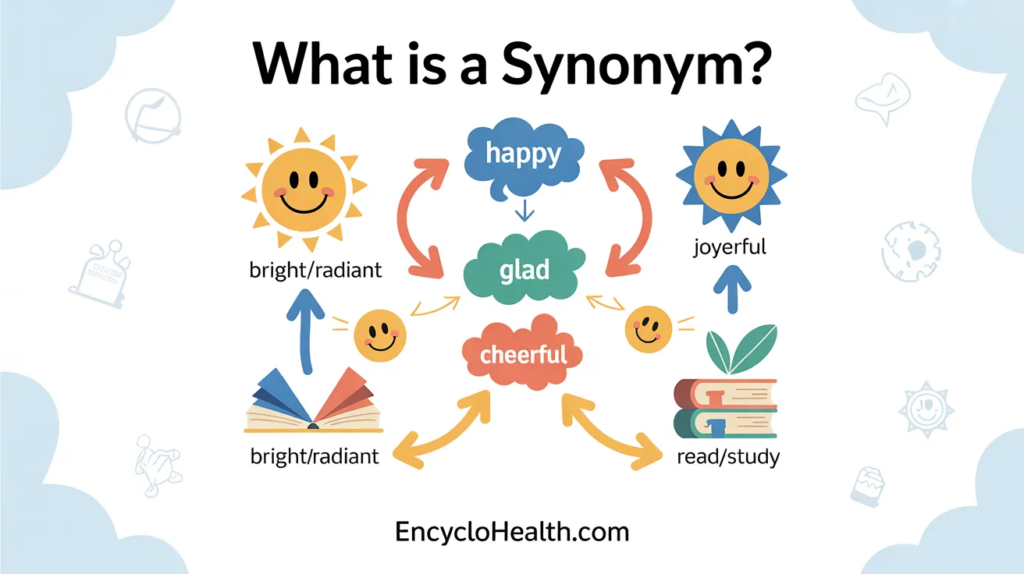
Start with anchor words — common, everyday words like “good,” “bad,” “big,” “small,” “happy,” “sad.” Then build synonym clusters around each one. For “happy”: content, joyful, pleased, delighted, elated, ecstatic. Notice how the intensity increases along that chain.
Practice by replacing anchor words in your own writing. Write a paragraph using only simple words, then go back and replace where precision or variety would serve the reader better. This exercise is one of the fastest ways to sharpen your word sense.
Use flashcard apps like Anki or Quizlet to study synonym clusters. Seeing words in groups, rather than in isolation, helps the brain store them relationally — which is how natural language recall actually works.
Conclusion
So — what is a synonym? It’s more than just a word that means the same thing as another word. It’s a tool for precision, tone, clarity, and creativity. It’s the difference between writing that feels flat and writing that feels alive. It’s one of the most practical concepts in the English language, and one of the most powerful when used well.
The next time you catch yourself using the same word twice in a paragraph, don’t just reach for any synonym — reach for the right synonym. Think about tone, context, formality, and connotation. Ask yourself what feeling you want to create. Then choose the word that does exactly that.
Word choice is one of the quietest superpowers in writing. Synonyms are a huge part of how you develop it.
What’s your go-to strategy for finding the right word? Drop your thoughts — or share this with someone who’s trying to level up their writing.
FAQs
1. What is a synonym in simple terms? A synonym is a word that has the same or very similar meaning as another word. For example, “happy” and “joyful” are synonyms.
2. Are synonyms exactly the same in meaning? Not always. Most synonyms are near-synonyms — they share a core meaning but differ in tone, intensity, or formality. True absolute synonyms are very rare.
3. What is a synonym versus an antonym? A synonym shares meaning with another word. An antonym is its opposite. “Cold” and “chilly” are synonyms. “Cold” and “hot” are antonyms.
4. Why should I use synonyms in my writing? Synonyms prevent repetition, add precision, improve tone, keep readers engaged, and help convey exactly the right meaning in any given context.
5. Can synonyms be used interchangeably? Often, but not always. Context, register, and connotation all affect whether a synonym works in a specific sentence. Always check meaning and tone before swapping.
6. How do I find a good synonym? Use a thesaurus, but always verify unfamiliar words in a dictionary. Read the synonym in context, say it out loud, and trust your instincts about whether it sounds right.
7. What are some examples of synonyms? Start/begin/commence, angry/furious/mad, beautiful/pretty/gorgeous, walk/stroll/march, eat/devour/consume — these are all common synonym groups.
8. Are synonyms important for SEO? Yes. Using synonyms naturally in web content helps capture related search queries without keyword stuffing, and it keeps your writing readable for human audiences too.
9. What is a contextual synonym? A contextual synonym only works in specific situations. For example, “bright” can mean intelligent or luminous — so its synonym changes depending on which meaning is being used.
10. How can I improve my synonym vocabulary? Read widely, study word clusters around anchor words, practice replacing common words in your own writing, and use vocabulary apps that teach words in related groups.
Also Read ; South Africa National Cricket Team VS India National Cricket Team
| Author: Johan Harwen |
| E-mail: johanharwen314@gmail.com |
| Bio: Johan Harwen is a passionate tourist who has explored countless destinations across the globe. With an eye for hidden gems and local cultures, he turns every journey into an unforgettable story worth sharing. |