
Stunning LEGO Titanic: Build History’s Most Iconic Ship 2026
Introduction
Have you ever dreamed of building one of history’s most famous ships, brick by brick?
The LEGO Titanic isn’t just another building set. It’s a masterpiece that brings together engineering, history, and pure building joy. When LEGO released this set in November 2021, it became an instant sensation among builders worldwide.
This massive model stands over 4 feet long and contains more than 9,000 pieces. It’s currently the longest LEGO set ever created.
But here’s what makes it truly special: you’re not just snapping bricks together. You’re recreating a vessel that captured the world’s imagination over a century ago. Every detail matters. Every section tells a story.
In this guide, you’ll discover everything about the LEGO Titanic. We’ll explore its features, building experience, display options, and whether it’s worth your investment. Whether you’re a seasoned LEGO enthusiast or considering your first major build, this article will help you decide if the LEGO Titanic belongs in your collection.
Let’s dive into what makes this set legendary.
What Makes the LEGO Titanic Special?
Record-Breaking Size and Scale
The LEGO Titanic holds a special place in LEGO history.
At 53 inches (135 cm) long, it’s the longest LEGO set ever produced. It towers over previous record holders like the Star Destroyer and Colosseum sets. The scale is 1:200, which means every detail is carefully proportioned to match the original ship.
The set includes:
- 9,090 pieces total
- Three main hull sections that connect
- Over 4 feet of pure LEGO engineering
- A display stand with nameplate
When you place this model on display, people notice. The sheer size commands attention. I’ve heard from builders who say guests always ask about it first, before anything else in their collection.
Historical Accuracy and Detail
LEGO didn’t cut corners with historical accuracy.
Every detail reflects the real RMS Titanic. The designers worked with Titanic historians to ensure authenticity. You’ll find accurate features throughout the build.
The ship includes:
- Detailed bridge and captain’s quarters
- Grand staircase sections
- Promenade deck with benches
- Lifeboats in davits
- Four iconic smokestacks
- Detailed hull plating
The LEGO Titanic captures both the elegance and engineering of the original vessel. The color scheme matches historical records. The proportions feel right. When you step back and look at the completed model, you see the Titanic, not just a LEGO interpretation.
Interior Cross-Sections
Here’s where the LEGO Titanic truly shines.
The model splits into three sections. When you remove the outer hull pieces, you see detailed interior spaces. This cross-section design lets you explore the ship’s inner workings.
You can view:
- Boiler rooms with detailed machinery
- Multiple passenger decks
- Cargo holds
- Engine rooms with pistons
- First-class dining areas
This feature makes the set educational. You understand how the Titanic was constructed. You see how different decks connected. It transforms the build from a static model into a learning experience.
The Building Experience
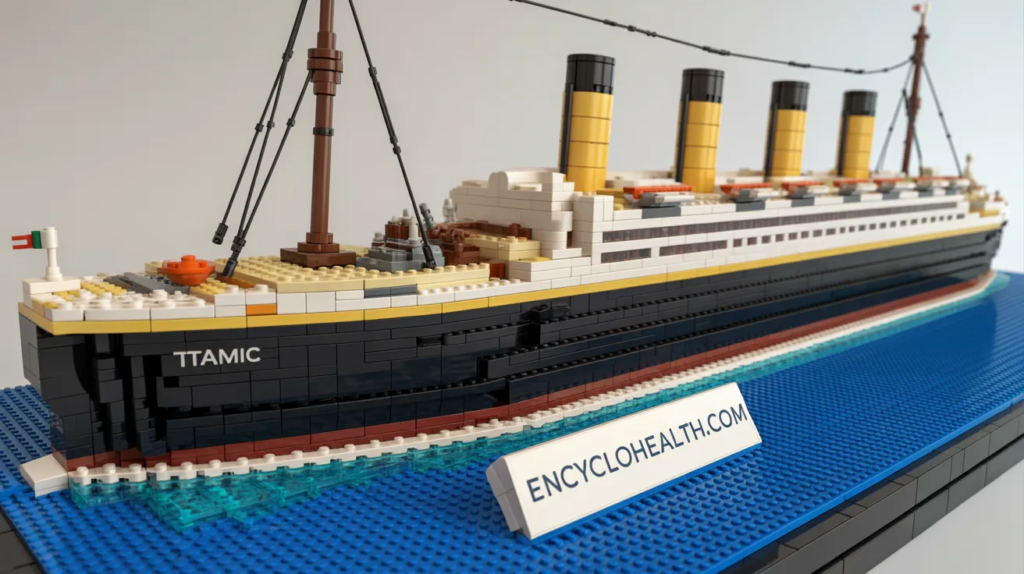
What to Expect During Construction
Building the LEGO Titanic is a journey, not a sprint.
Most builders report 40-60 hours of construction time. Some take longer, savoring each step. Others work faster, completing sections in marathon building sessions. There’s no right way to approach it.
The instruction manual spans multiple books. Each book covers a specific section of the ship. The instructions are clear and well-organized, as you’d expect from LEGO.
You’ll build:
- The bottom hull first
- Interior machinery and details
- Deck structures progressively
- Superstructure and funnels
- Final detailing and railings
The build process feels methodical. You’re constantly progressing. Each bag brings new elements to life. The satisfaction builds (pun intended) with every completed section.
Challenging Sections
Not every part of the LEGO Titanic is straightforward.
Some sections require patience and precision. The hull structure uses SNOT (Studs Not On Top) techniques extensively. You’ll attach pieces at angles, creating smooth curves and realistic plating.
The most challenging parts include:
- Curved hull sections requiring careful alignment
- Intricate interior machinery
- Delicate railing installations
- Securing the three main sections together
I’ve read about builders who needed to backtrack when pieces didn’t align perfectly. That’s normal. Take your time. Don’t force connections. If something feels wrong, it probably is.
The superstructure and funnels are more straightforward. By the time you reach them, you’ll have mastered the building techniques.
Tips for Building Success
Want to make your LEGO Titanic build smoother?
Here are practical tips from experienced builders:
Organize your workspace. This set has thousands of pieces. Sort them by bag number. Use containers or trays. You’ll save hours of searching.
Build in sessions. Don’t rush. Break the build into manageable chunks. Complete one instruction book at a time.
Check your work frequently. Compare your progress to the instructions every few steps. It’s easier to fix mistakes early than to disassemble large sections later.
Work on a stable surface. The hull sections are heavy and fragile during construction. Use a large, flat table. Make sure you have plenty of room.
Handle with care. The model becomes sturdy when complete, but individual sections can be delicate. Support the hull properly when moving sections.
Take breaks. Stretch. Enjoy the process. The LEGO Titanic isn’t a race. It’s an experience.
Display and Storage Considerations
Space Requirements
Before buying the LEGO Titanic, measure your space.
This model demands room. The completed ship measures:
- Length: 53 inches (135 cm)
- Height: 18.3 inches (46 cm) including stand
- Width: 7 inches (18 cm)
You’ll need a dedicated display area. A standard bookshelf won’t work. Consider these options:
Wall-mounted shelves. Install a long, sturdy shelf specifically for the Titanic. Ensure it can handle the weight (approximately 20 pounds).
Display tables. Some builders use dedicated display tables. This works well if you have floor space.
Custom cabinets. For dust protection, consider a custom display cabinet with glass doors. This adds cost but protects your investment.
Think about viewing angles too. The LEGO Titanic looks best when viewed from the side. Position it where people can appreciate its length.
Dust Management
Dust is the enemy of displayed LEGO sets.
The Titanic’s complex surface catches dust easily. The railings, lifeboats, and detailed superstructure are dust magnets. Without protection, you’ll spend time cleaning.
Dust management strategies:
Display cases. The best solution. IKEA Besta units work well with custom shelving. Acrylic display cases are available but expensive for this size.
Regular cleaning. Use a soft brush or compressed air. Clean gently. Aggressive cleaning can dislodge small pieces.
Location matters. Avoid high-traffic areas where dust accumulates quickly. Keep the model away from vents and fans.
Some builders apply a light coating of dust-resistant spray. Test this on spare pieces first. You don’t want to damage your finished build.
Transporting the Model
Moving the LEGO Titanic requires planning.
The model isn’t designed for frequent movement. The three main sections connect but aren’t indestructible. Small details can break off during transport.
If you must move it:
- Separate the three main hull sections
- Support each section from underneath
- Move slowly and carefully
- Have someone help you
- Transport in a vehicle, not by hand over distances
For permanent moves, some builders partially disassemble the superstructure. This reduces risk. You can rebuild small sections after moving.
Is the LEGO Titanic Worth the Investment?

Price Point Analysis
The LEGO Titanic retails for $679.99 USD.
That’s a significant investment. It’s LEGO’s second most expensive set (after the Eiffel Tower). But let’s break down the value.
Price per piece: With 9,090 pieces, you’re paying about 7.5 cents per piece. That’s reasonable for a set this complex. Specialized pieces and unique elements justify the cost.
Build time value: At 40-60 hours of building, you’re paying roughly $11-17 per hour of entertainment. Compare that to movies, concerts, or other hobbies. The value looks better.
Display value: This is a permanent display piece. Unlike consumable entertainment, you keep enjoying it. The LEGO Titanic appreciates in value over time, unlike most purchases.
For LEGO enthusiasts, the price feels justified. For casual builders, it’s definitely a splurge.
Who Should Buy This Set?
The LEGO Titanic isn’t for everyone.
This set works best for:
Experienced builders. You should have several large LEGO sets under your belt. The techniques aren’t beginner-friendly.
History enthusiasts. If you love the Titanic story, this set brings history to life. Every detail connects to the real ship.
Display collectors. You need space and a desire to showcase your build. This isn’t a build-and-box set.
Patient builders. Rushing ruins the experience. You should enjoy long building sessions and attention to detail.
This set doesn’t work well for:
- Limited display space situations
- Builders seeking play features
- People who frequently move homes
- Those seeking maximum play value per dollar
The LEGO Titanic is a display piece and building challenge first, everything else second.
Comparing to Other Large LEGO Sets
How does the LEGO Titanic compare to other flagship sets?
VS. LEGO Colosseum (9,036 pieces, $549.99): The Colosseum offers repetitive building. It’s impressive but less varied. The Titanic provides more building variety and historical connection.
VS. LEGO Star Wars UCS sets: Sets like the Millennium Falcon (7,541 pieces, $849.99) offer play features and pop culture appeal. The Titanic focuses purely on display and accuracy.
VS. LEGO World Map (11,695 pieces, $299.99): More pieces, lower price, but completely different experience. The World Map is meditative building. The Titanic is engineering challenge.
The LEGO Titanic stands alone. No other set combines its size, historical accuracy, and engineering complexity. If you want something truly unique, this is it.
Common Questions and Concerns
Durability and Stability
Many potential buyers worry about stability.
The LEGO Titanic is surprisingly sturdy when built correctly. The three hull sections lock together firmly. The internal structure provides support throughout.
Weak points to watch:
- Small railings can break if bumped
- Lifeboats may detach from davits
- Funnels are secure but vulnerable to top-down pressure
Once on display, the model stays solid. Just don’t let kids or pets near it. Treat it like any valuable display piece.
Missing Pieces
What if you lose or break a piece?
LEGO’s customer service is excellent. You can order replacement pieces through their website. They’ll send missing pieces free for a reasonable time after purchase.
For broken pieces, replacements cost pennies. The LEGO Titanic uses mostly standard pieces, available individually.
Keep leftover pieces. The set includes extras for small parts. Store them safely.
Building Alone vs. With Others
Should you build the LEGO Titanic solo or with someone?
This is personal preference. The set works both ways.
Solo building benefits:
- Move at your own pace
- Focus without interruption
- Personal sense of accomplishment
- Meditative, relaxing experience
Building with others:
- Share the experience
- Divide challenging sections
- Faster completion
- Creates shared memories
Some builders do both. They construct alone but display progress to family. Others make it a partner or parent-child project.
The instruction books divide naturally into sections. Two people can work on different parts simultaneously.
The History Behind the Model

Why LEGO Chose the Titanic
The Titanic is universally recognized.
LEGO targets adult builders with sets that resonate emotionally. The Titanic story combines tragedy, engineering marvel, and historical significance. Everyone knows it.
The timing was right too. LEGO’s adult-focused line was expanding. They’d proven success with architectural and historical sets. The LEGO Titanic fits perfectly into this strategy.
The design team studied the ship extensively. They consulted historians and examined blueprints. They visited museums with Titanic artifacts. This research shows in every detail.
Educational Value
Building the LEGO Titanic teaches multiple subjects.
Engineering: You learn about ship construction. The hull’s structure becomes clear. You understand why certain design choices were made.
History: The model encourages research. Builders often read about the Titanic while building. The set includes a booklet with historical information.
Scale and proportion: Working at 1:200 scale teaches spatial reasoning. You visualize how massive the real ship was.
Parents report that kids become fascinated with naval architecture. Teachers use images of the set in history lessons. The LEGO Titanic makes history tangible.
Maintenance and Long-Term Care
Keeping Your Titanic Pristine
Maintaining the LEGO Titanic requires minimal effort.
Monthly dusting: Use a soft makeup brush or compressed air. Work gently around delicate parts. Don’t spray compressed air too close—it can dislodge pieces.
Annual deep cleaning: Once yearly, carefully remove the model from its stand. Check for loose pieces. Gently clean hard-to-reach areas.
Structural checks: Periodically verify that the three main sections remain firmly connected. Reseat them if needed.
Sunlight protection: UV light fades LEGO bricks over years. Don’t display in direct sunlight. Use UV-protected glass if using a display case.
Proper care keeps the LEGO Titanic looking new for decades. These bricks don’t degrade if protected from sunlight and physical damage.
Repair and Restoration
What if something breaks?
Small repairs are straightforward. Reattach loose pieces following the instructions. The manual is clear enough to find any section.
For major damage (like dropping a hull section), you’ll need patience. Disassemble the damaged area. Rebuild carefully. This is time-consuming but manageable.
The worst-case scenario is catastrophic damage. In this case, LEGO’s parts ordering service saves you. You can replace any broken piece. It’s tedious but possible to restore the set completely.
Insurance considerations: Some homeowner’s policies cover valuable collectibles. The LEGO Titanic qualifies. Consider documenting your build with photos for insurance purposes.
Conclusion
The LEGO Titanic represents the pinnacle of adult LEGO building.
It’s massive, detailed, and historically significant. The building experience challenges you. The display value is unmatched. For serious LEGO enthusiasts and Titanic admirers, it’s an obvious choice.
Yes, it’s expensive. Yes, it requires space. Yes, you’ll invest dozens of hours building it.
But here’s the thing: you’ll treasure every moment. The satisfaction of completing such an iconic model stays with you. Every time you pass by your displayed Titanic, you’ll feel proud.
The LEGO Titanic isn’t just a toy. It’s a conversation piece, a historical monument, and a personal achievement. It connects you to one of history’s most famous ships.
If you have the space, the budget, and the passion, this set deserves a place in your collection.
Are you ready to set sail on your LEGO Titanic building adventure? Share your building experience or questions in the comments below. Your journey with this magnificent set starts with a single brick.
FAQs
How long does it take to build the LEGO Titanic?
Most builders complete the LEGO Titanic in 40-60 hours. Your speed depends on experience and how many sessions you spread it across. Some finish in a weekend marathon, others take several weeks of evening building.
Is the LEGO Titanic suitable for children?
The set is rated 18+ for good reason. It’s complex and not designed for play. Younger builders might help with supervision, but this is really an adult-focused building experience.
How much does the LEGO Titanic weigh?
The completed model weighs approximately 20 pounds (9 kg). The weight comes from thousands of bricks and the sturdy internal structure. Make sure your display shelf can handle this load.
Can you separate the LEGO Titanic into sections?
Yes, the model divides into three main hull sections. This design allows you to view interior details and makes transportation possible. The sections connect firmly but can be separated carefully.
Does the LEGO Titanic float?
No, absolutely not. The model isn’t watertight and would sink immediately. It’s a display piece only. Water would damage the bricks and internal structure. Never attempt to float it.
Where can I buy the LEGO Titanic?
Purchase from LEGO’s official website, LEGO stores, or authorized retailers like Amazon and Target. Be cautious of third-party sellers charging above retail price. Verify seller authenticity to avoid counterfeit sets.
What’s the difference between the LEGO Titanic and other ship sets?
The LEGO Titanic is the longest LEGO ship ever created. It focuses on historical accuracy and display value. Unlike playsets, it features detailed interiors and realistic proportions at 1:200 scale.
How difficult is the LEGO Titanic to build?
It’s challenging but manageable for experienced builders. The instructions are clear. The difficulty comes from the sheer size, piece count, and advanced techniques like SNOT building. Patience matters more than skill.
Will the LEGO Titanic increase in value?
Historically, large LEGO sets appreciate after retirement. The Titanic’s size, popularity, and uniqueness suggest good long-term value. However, buy it for enjoyment, not purely as an investment.
Can you customize or modify the LEGO Titanic?
Yes, many builders add custom details or lighting. Some install LED lights throughout the interior. Others add additional lifeboats or modify the display stand. Customization is possible but requires additional pieces and skill.
Also Read : How to Spell Chose